
Written by Stuart Preston, Cingularis
At a recent session at The CATALYST, Stuart “Zero” Preston of Cingularis gave small business owners a practical look at how AI can fit into everyday work.
His message was simple: AI can do a lot, and small business owners get the most value when they stay closely involved in the work.
Stuart framed the session around one idea that came up throughout the presentation:
“Lead with your heart. Finish with your brain.”
Download the presentation and workbook here.
AI Can Help, But Context Matters
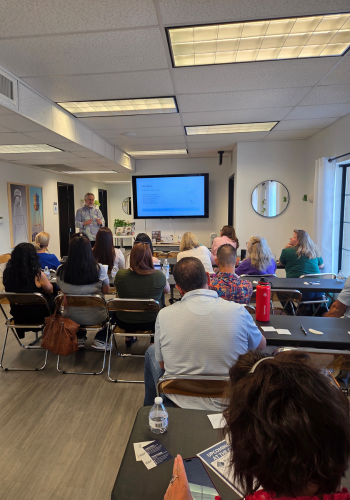
Stuart began with a short explanation of what AI actually does. It learns patterns from data, predicts what comes next, generates responses, and can now handle increasingly complex work.
That capability makes AI useful for far more than writing social posts or answering questions.
The quality of the work depends heavily on the context people give it.
Stuart encouraged attendees to give AI information about their purpose, experience, expertise, voice, customers, values, and point of view. The more AI knows about the person and business behind the work, the better chance it has of producing something useful.
One of his suggestions was simple: let AI interview you.
Business owners can tell AI what they are working on and ask it to interview them one question at a time. Stuart recommended answering with voice-to-text, which helps capture the way people naturally speak, including stories, opinions, humor, and phrases that might disappear in more formal writing.
Watch For “Soul Drift”
Stuart also introduced what he calls “soul drift.”
It happens when people start handing more of their thinking to AI and gradually stop adding their own perspective.
The warning signs are easy to recognize: writing becomes generic, expertise disappears, opinions soften, and everything starts to sound like everything else.
He also pushed the idea of “AI slop” beyond bad writing.
AI slop can show up as an idea someone does not really believe, advice they would never give, empathy they did not feel, or a decision they never truly made.
Sometimes the result still sounds polished.
That is exactly why judgment matters.
Teach AI Who You Are Once
Another practical takeaway centered on giving AI useful context it can reuse.
Tools such as Custom GPTs, Claude Projects, and Gemini Gems can give business owners a place to save instructions, examples, preferences, files, and guardrails.
Stuart encouraged attendees to think about their own “ethos” as part of that setup.
What do they care about?
What will they never compromise?
How should customers feel after working with them?
What parts of the work still need a human involved?
Those answers can become instructions that guide future AI work.
AI Gets More Useful When It Can See Your Business
The session then moved into a bigger idea: AI can work across email, calendars, files, accounting systems, meeting notes, spreadsheets, and other business tools.
That opens the door to a different kind of use.
Stuart shared a recent example from his own client work. Several people on a client’s team had promised to send him documents. He used AI to review meeting notes and email, identify what each person had promised, create follow-ups, build a tracking spreadsheet, and help keep it updated as documents arrived.
His summary drew a laugh:
“Could I do all that myself? Sure. I wouldn’t have.”
The point landed with the room because it had very little to do with writing a clever prompt.
It was actual work.
AI Can Also Help Find Missed Opportunities
Stuart shared another example from his own business.
He asked AI to review his sales history, calendar, email, and past conversations, then answer two questions:
What did I forget?
Who else can I help?
The goal was to surface stalled opportunities, forgotten follow-ups, past customers, and people who might benefit from another service.
The information already existed inside the business. AI made it easier to look across all of it at once.
Stuart also described other work he regularly hands to AI, including presentation drafts, proposals, meeting preparation, research, and finding information buried in old emails or notes.
The Workshop Turned The Question Back To Attendees
The hands-on portion of the session asked participants to look at their own schedules.
They listed recurring work, follow-up tasks, meetings, and the work that happens around those meetings. Attendees were also encouraged to take a screenshot of a typical week on their calendar and give that information to AI.
Then came the question:
“What can you take off my plate?”
Stuart encouraged attendees to push past the first answer.
He suggested asking AI:
“Look harder. What am I doing manually that you could do for me, monitor for me, prepare for me, or remind me about?”
Then he added one more question:
“Which of these still needs my judgment, expertise, creativity, or relationship?”
That final question brought the session back to the human side of the conversation.
What Still Needs You?
Stuart closed with the reminder that AI can read more information than any person ever could.
It still has not lived anyone’s life.
It does not have a business owner’s history, relationships, sense of humor, instincts, or experience.
Those things still matter.
His closing line summed up the session:
“AI can accelerate your business. Only you can create meaning.”
For small business owners sorting through the flood of new tools, models, and promises, the takeaway was practical: give AI useful context, look for real work it can help with, and stay involved where your experience and judgment matter.
For more ideas and resources on AI for small business, visit Cingularis.