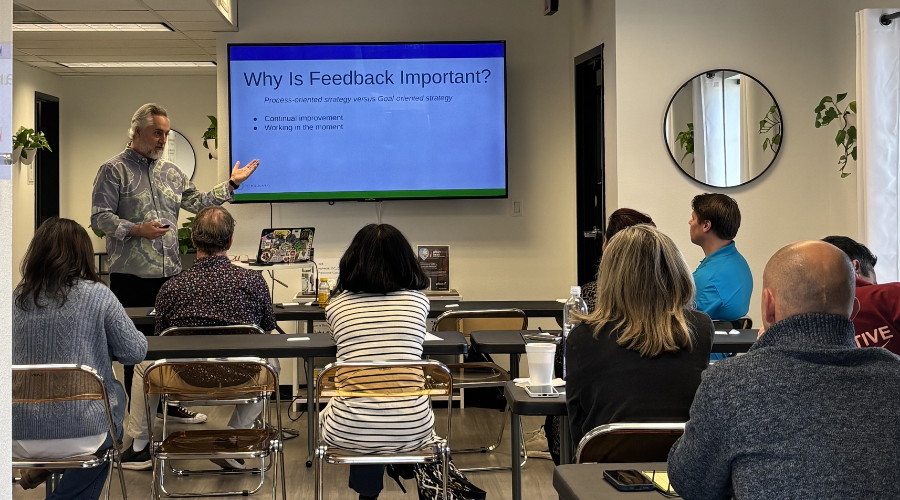
The CATALYST recently hosted Customer Service and Experience Feedback and Improvement: Collecting and Using Customer Feedback to Improve Products and Services, facilitated by Stuart Preston of Cingularis. The session explored a powerful growth strategy that many businesses overlook: listening closely to customers and using their feedback to drive continual improvement.
The workshop focused on three essential areas:
- How to collect meaningful customer feedback
- How to use feedback to strengthen operations and revenue
- How AI tools can simplify the process
At its core, the session encouraged business owners to shift their mindset about growth.
Continual Improvement in the Moment
Early in the session, Stuart introduced a process-driven approach to business improvement. Instead of focusing only on large goals such as revenue targets or expansion plans, he encouraged attendees to focus on what he called continual improvement.
He shared the coaching philosophy of Nick Saban, former head coach of the Alabama Crimson Tide. Saban trained his players to focus on the play directly in front of them. After each play, they assess performance, adjust, and move forward. They do not dwell on the scoreboard. They concentrate on execution in the moment.
Small business owners often replay past mistakes or worry about future outcomes. Stuart challenged attendees to focus on what they can improve today.
“It gets easier. Every day it gets a little easier. But you’ve got to do it every day. That’s the hard part. But it does get easier,” Stuart shared during the session – a direct quote from the TV show BoJack Horseman.
The message resonated throughout the room. Growth comes from consistent action, not isolated effort.
How Feedback Directly Impacts Growth
Stuart described customer feedback as a free business consultant. Ignoring it leaves opportunity on the table.
He outlined three primary areas where feedback fuels growth.
Marketing
Positive reviews increase trust and visibility. They improve search performance and influence buying decisions. Social listening often sparks new ideas for content, services, and promotions.
Research shows that a one-star increase in Yelp rating can lead to a 5 to 9 percent increase in revenue for independent restaurants. Reputation connects directly to revenue.
Leadership and Culture
Customers often see blind spots leaders miss. Organizations that consistently listen to feedback tend to outperform those that do not.
Stuart shared an example from a Startup Weekend event he once organized. A simple public request on Twitter for support drew immediate responses from technology companies that were monitoring online conversations. Those companies paid attention. They listened. That awareness created opportunity.
The lesson was clear: listening leads to growth.
Customer Experience and Retention
Customer loyalty is fragile. One in three customers will leave a brand they love after a single bad experience. Retention has a measurable financial impact. A 5 percent increase in customer retention can boost profits by 25 to 95 percent.
Stuart reflected on his time serving on a churn committee earlier in his career. The team analyzed why clients were leaving. The breakthrough came when they focused less on stopping departures and more on improving systems based on what customers shared.
“Retaining a customer is far more valuable than constantly chasing a new one,” Stuart explained. “If they know you’re listening and you care, they’re much more likely to stay when you make a mistake.”
The Many Ways to Gather Feedback
Feedback includes both what customers say and what they do.
Direct Feedback
- Online reviews and ratings
- Short, focused surveys
- Net Promoter Score surveys
- Social media polls
Higher Net Promoter Scores correlate with stronger profitability. Simple questions can reveal powerful insight.
Indirect Feedback
- Retention and churn rates
- Purchase behavior
- Support ticket patterns
- In-person cues in service businesses
Behavior often reveals issues before customers formally complain.
Turning Feedback into Action
Collecting feedback alone does not create change. Stuart outlined four practical steps for implementation.
1. Identify Patterns
One negative review may be an outlier. Multiple reviews highlighting the same issue signal a trend. Patterns point to opportunities.
2. Prioritize Fixes
Categorize improvements:
- Urgent issues affecting safety, revenue or reputation
- High-impact changes that increase loyalty
- Lower-priority enhancements
Clear priorities prevent overwhelm.
3. Respond and Engage
Customers expect acknowledgment. Public responses show transparency and build trust. Thoughtful replies often strengthen loyalty.
4. Close the Loop
Let customers know their input made a difference. Train staff to request feedback regularly. Keep the process active.
As Stuart emphasized, feedback only creates growth when businesses act on it.
“You can collect all the feedback in the world,” he noted. “But if you don’t act on it, nothing changes.”
How AI Supports the Feedback Process
The session also explored how AI tools can support feedback systems.
AI can:
- Automate survey outreach and review requests
- Analyze large volumes of reviews for recurring themes
- Identify common words in negative and positive feedback
- Alert business owners to emerging issues
For example, business owners can analyze one- to three-star reviews to uncover recurring language such as slow, confusing, or unresponsive. Reviewing positive feedback can reveal strengths customers consistently value.
AI increases speed and clarity, allowing business owners to focus on meaningful conversations and strategic adjustments.
Final Takeaway
The workshop concluded with a simple framework:
Collect. Analyze. Act. Repeat.
Marketing creates awareness. Advertising drives traffic. Sustainable growth comes from referrals. Referrals come from customers who feel heard.
Businesses that master feedback do more than grow. They build loyal customers who advocate on their behalf.
When leaders commit to listening, adjusting, and improving one step at a time, progress follows.
Resources: