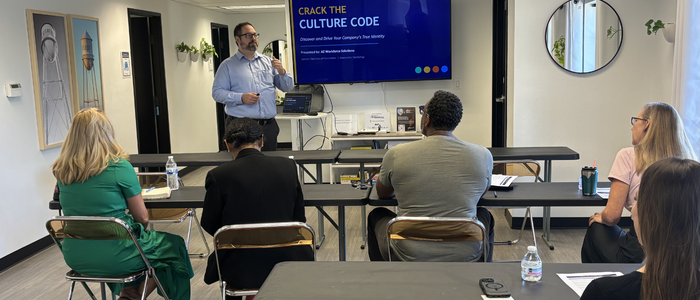
Business owners and leaders came together at The CATALYST for Crack the Culture Code: Discover and Drive Your Company’s True Identity, a hands-on workshop facilitated by James Moncol of AZ Workforce Solutions. The session challenged attendees to move beyond surface-level perks and take a deeper, more strategic look at what truly defines their organization: culture.
James opened with a compelling reality check—71% of leaders say culture and team cohesion are critical to success, yet many organizations struggle to clearly define or communicate theirs. The cost of that disconnect is significant. On average, replacing a single employee can cost 50% to 200% of their annual salary, reinforcing a key takeaway from the workshop: culture is not a “nice to have,” it’s a business imperative.
Just as important as building a strong internal culture is articulating it externally. Today’s workforce is more intentional than ever. Candidates aren’t just evaluating salary and benefits—they’re asking, What does it feel like to work here? Do I belong here? Organizations that can clearly communicate their culture have a measurable advantage in attracting and retaining the right talent.
It also becomes significantly more difficult to hire and retain the right employees when culture isn’t clearly defined. Without that clarity, organizations often struggle to identify what type of team member they truly need, leading to mismatched hires and higher turnover. When expectations are unclear, both employers and employees can feel misaligned. On the other hand, when a company can clearly communicate who they are, what they value, and what employees can expect day-to-day, it creates alignment from the start—resulting in stronger hires, better retention, and a more engaged workforce. When both sides understand the fit, everyone wins.
The 4 Types of Company Culture
A core component of the workshop was identifying and understanding the four primary culture types. Most organizations have a dominant type, often supported by a secondary one. The goal isn’t to fit perfectly into a box—it’s to gain clarity and alignment.
1. Clan Culture (The Family) This culture prioritizes people, relationships, and a sense of belonging. Organizations with a clan culture focus on collaboration, mentorship, and employee well-being. Success is measured by engagement, loyalty, and low turnover.
2. Adhocracy Culture (The Innovator) Fast-paced and forward-thinking, adhocracy cultures thrive on creativity and risk-taking. These organizations value new ideas, experimentation, and disruptive thinking. Employees are motivated by the opportunity to build and innovate.
3. Market Culture (The Competitor) Results-driven and performance-focused, market cultures emphasize hitting goals, driving revenue, and staying competitive. Clear metrics, incentives, and recognition programs are central to motivating teams in this environment.
4. Hierarchy Culture (The Controller) Structured and process-oriented, hierarchy cultures value stability, efficiency, and clear expectations. Success is defined by consistency, operational excellence, and well-defined systems.
From Awareness to Action
Participants weren’t just learning—they were actively applying. Throughout the session, attendees were challenged to evaluate what their company culture looks like today versus what they want it to look like in the future. This reflection pushed leaders to identify any gaps between intention and reality.
From there, the focus shifted to execution: How will you communicate your culture clearly and consistently? Whether through job postings, onboarding experiences, leadership behaviors, or day-to-day interactions, participants explored how to align messaging with lived experience. The takeaway was clear—defining culture is only the first step; reinforcing it at every touchpoint is what makes it real.
One of the most impactful insights was this: Culture is already happening—whether you define it or not. The opportunity lies in shaping it intentionally and communicating it clearly.
For businesses looking to grow, hire, and retain effectively, the message was clear: Your culture is your brand. Define it. Live it. Share it.