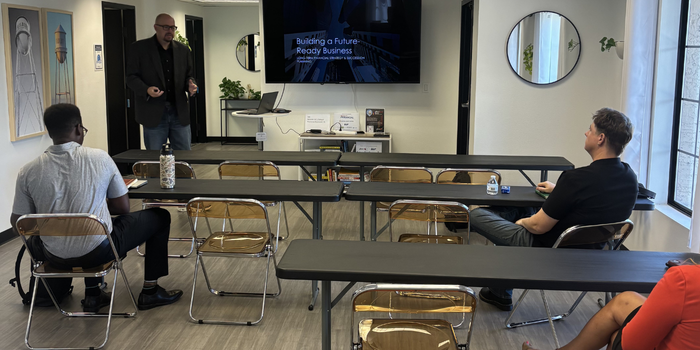
Long-term business success does not happen by accident. It is built through intentional planning, financial discipline, and a willingness to prepare for both opportunity and uncertainty. During our recent workshop, Building a Future-Ready Business: Long-Term Financial Strategy & Succession Planning, participants explored practical strategies to strengthen their businesses for sustainable growth and long-term resilience.
Led by Gerry Tarling with Desert Financial Credit Union, the session focused on helping business owners move beyond short-term decision-making and begin building a stronger financial foundation for the future. Participants were reminded that while growth is important, sustainable growth requires preparation, strategy, and adaptability.
One of the major themes of the workshop was the importance of aligning financial decisions with long-term business goals. Participants discussed how annual forecasting, intentional reinvestment, and monitoring key financial ratios can help business owners make proactive decisions rather than reactive ones. Instead of simply responding to immediate challenges, businesses that plan ahead are better positioned to navigate economic cycles, invest strategically, and remain stable during periods of uncertainty.
The workshop also emphasized the value of scenario planning. Business owners were encouraged to think through best-case, most likely, and worst-case scenarios in order to better prepare for changing market conditions. By modeling different outcomes, businesses can identify potential risks early, build financial reserves, and create contingency plans that protect operations during difficult periods.
Participants were challenged to think critically about their own long-term vision by identifying a three-to-five-year financial goal for their business. This activity encouraged attendees to reflect on future revenue targets, necessary investments, growth opportunities, and ways to improve financial stability through stronger margins, consistent cash flow, and reserve planning.
Retirement planning was another key topic covered during the session. Many business owners rely heavily on their business as their primary financial asset, but the workshop highlighted the importance of diversifying outside the business and utilizing tax-advantaged retirement accounts. Attendees learned about retirement options such as Solo 401(k)s, SEP IRAs, SIMPLE IRAs, and Defined Benefit Plans, along with how each option can support different business structures and long-term financial goals.
A significant portion of the workshop focused on succession and exit planning. Participants explored how preparing future leaders, documenting key processes, and creating transition plans can protect both business continuity and long-term business value. Whether an owner plans to sell the business, transfer it to family members, merge with another company, or gradually step back over time, having a clear succession strategy reduces operational risk and increases confidence for buyers, lenders, employees, and customers.
The session also highlighted how documentation, clean financial statements, and strong leadership development can directly increase business valuation. Businesses that operate independently of the owner are often more attractive to buyers and investors because they demonstrate stability and reduced risk.
In addition to long-term planning, participants reviewed important performance metrics that help measure business health and sustainability. Key indicators such as revenue growth, net profit margin, cash flow, customer retention, and debt levels were discussed as essential tools for evaluating progress and identifying areas that may require attention. Attendees also explored practical tracking tools like Excel dashboards, QuickBooks, monthly KPI reviews, and annual business evaluations to help maintain visibility into financial performance.
Another important takeaway from the workshop was the importance of building a financial cushion. Business owners were encouraged to maintain three to six months of reserves to help stabilize operations during slow seasons, unexpected expenses, or economic downturns. The discussion reinforced that strong reserves provide business owners with flexibility and allow for more thoughtful decision-making during periods of stress.
As the workshop concluded, participants reflected on one commitment they could make within the next 90 days to strengthen their business for the future. From improving financial organization to developing succession plans or increasing reserve savings, attendees left with actionable steps designed to support long-term growth and resilience.
The workshop served as a strong reminder that sustainable business success requires more than day-to-day management. It requires vision, preparation, and intentional financial leadership. By focusing on long-term strategy, business owners can build organizations that are not only profitable today, but resilient and future-ready for years to come.